Russian President Vladimir Putin ordered the partial mobilization of the Russian army on Sept. 21, the first military call-up of its kind since World War II. He thereby put all of Russia in danger of a response to his belligerency.
Kyiv and most Western capitals have roundly condemned the move.
“Russia has been, and remains, an aggressor, illegally occupying parts of Ukrainian land,” Ukraine’s foreign minister, Dmytro Kuleba, wrote on Twitter. “Ukraine has every right to liberate its territories and will keep liberating them whatever Russia has to say.”
Over the past 10 days, Ukrainian forces have achieved notable gains on the battlefield, retaking positions in the northeastern Kharkiv region, which sits adjacent to Donbas.
While the government in Kyiv is portraying the counteroffensive as a “turning point” in the conflict, Russian officials have downplayed its strategic importance.
Kyiv says it will never accept Russian occupation of its territory while continuing to call on its Western allies to supply it with increasingly advanced weaponry.
The European Union likewise condemned the planned polls, vowing not to recognize the results.
“Russia, its political leadership, and all those involved in these ‘referenda’ and other violations of international law in Ukraine will be held accountable,” EU foreign policy chief Josep Borrell said in a statement.
He went on to say that “additional restrictive measures against Russia would be considered” in light of the circumstances.
In a 2014 referendum, the Black Sea region of Crimea, which shares a border with Kherson province, voted to leave Ukraine and join Russia.
Unrecognized by all but a handful of countries, the Crimea poll came on the heels of Ukraine’s “Maidan Revolution,” which swept President Viktor Yanukovych, who was known to be close to Moscow, from power.
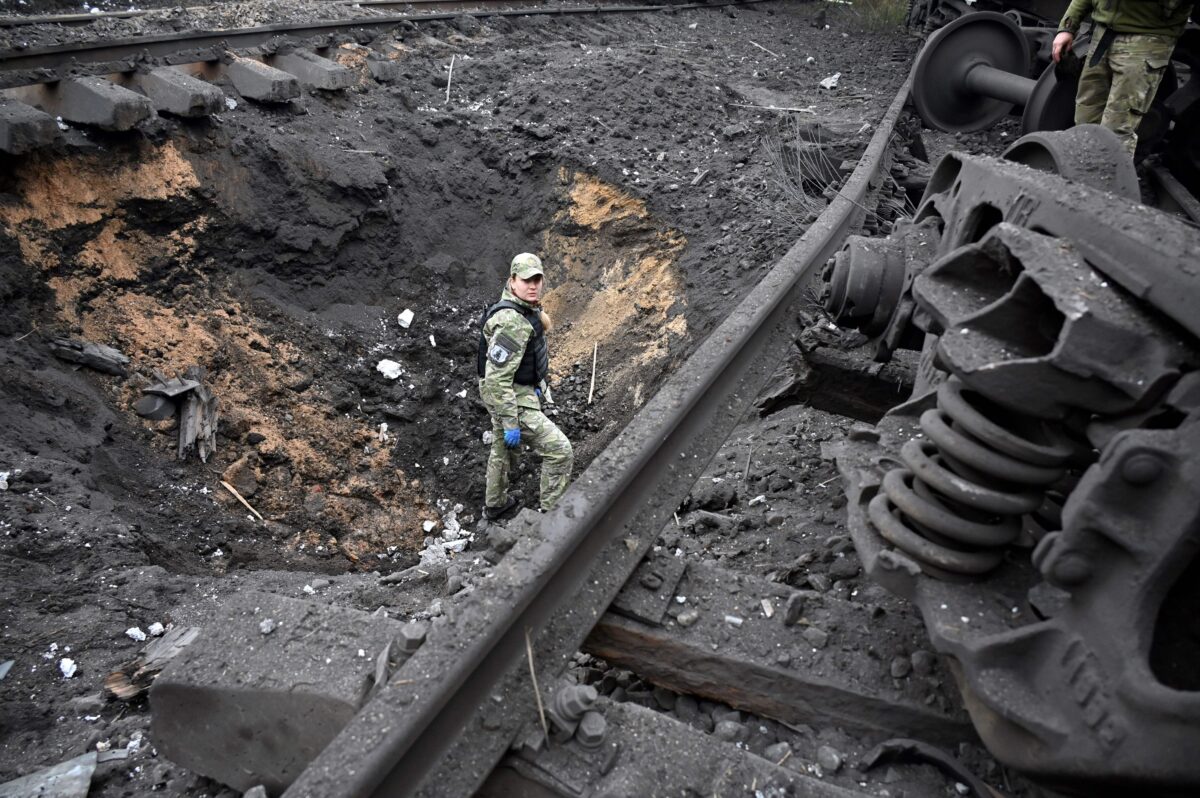
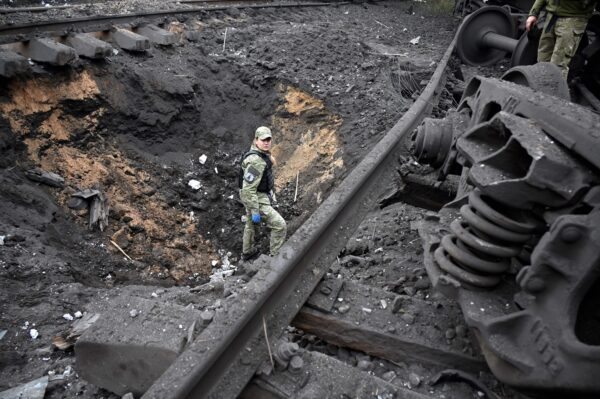 A forensic explosives expert examines a crater from a missile explosion at a freight railway station in Kharkiv on Sept. 21, 2022, amid Russia’s military invasion of Ukraine. (Sergey Bobok/AFP via Getty Images)
Moscow Mobilizes Military
Putin upped the ante on Sept. 21, announcing the partial mobilization—effective immediately—of Russia’s armed forces.
In a televised address, he said the decision was prompted by challenges posed by a roughly 1,000-kilometer-long (about 621 miles) frontline, as well as his claim that Russia was engaged in conflict with “the entire western military machine.”
Putin also denounced what he described as “pronouncements by representatives of leading NATO countries about the possibility and admissibility of using weapons of mass destruction against Russia.”
Speaking after a major summit of Eurasian leaders in Samarkand, Uzbekistan, on Sept. 16, Putin alleged that Western powers sought the breakup of Russia into ineffectual statelets.
According to Russia’s Defense Ministry, the fresh mobilization involves 300,000 reserve troops with previous military experience.
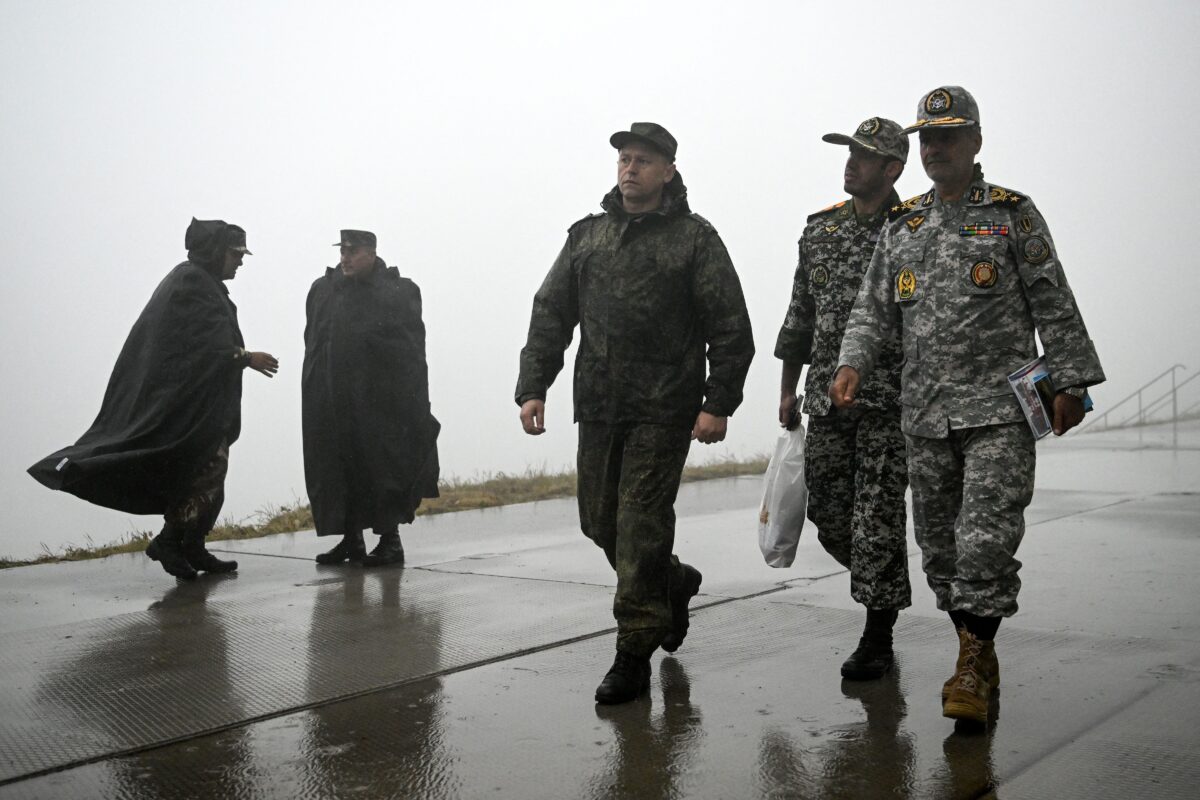
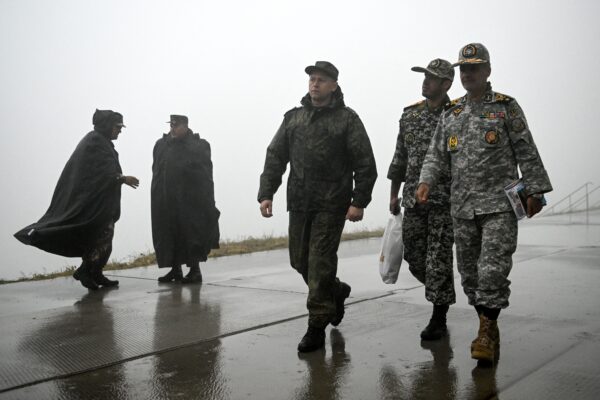 Military specialists take part in the ‘Vostok-2022’ military exercises at the Sergeevskyi District training ground outside the city of Ussuriysk in the Russian Far East on Sept. 6, 2022. (Kirill Kudryavtsev/AFP via Getty Images)
There’s little doubt that the incorporation of Luhansk, Donetsk, Kherson, and Zaporizhzhia into Russia—as happened in Crimea in 2014—would profoundly alter the nature of the conflict.
“Encroachment onto Russian territory is a crime which allows you to use all the forces of self-defense.” Dmitry Medvedev, deputy chairman of the Russian Security Council (and former Russian president), said in a Telegram post. “This is why these referendums are so feared in Kyiv and the West.”
In March, U.S. President Joe Biden said direct confrontation between NATO and Russia would risk triggering a third world war.
Despite the escalations, Ukrainian President Volodymyr Zelenskyy appeared upbeat.
“The situation at the front clearly indicates the initiative is with Ukraine,” he said in a Sept. 21 video address.
Meanwhile, U.S. Ambassador to Ukraine Bridget Brink described the moves by Moscow as “signs of weakness, of Russian failure.”
The United States, Brink wrote on Twitter, “will never recognize Russia’s claim to purportedly annexed Ukrainian territory.”
China, just days after Chinese leader Xi Jinping met with Putin in Uzbekistan, responded to the crisis by calling for “dialogue and consultation” and “a way to address the security concerns of all parties.”
NATO member Turkey, after Turkish President Recep Tayyip Erdogan also met with Putin in Samarkand, issued similar calls for “diplomacy and mediation.”
Speaking on the sidelines of a U.N. General Assembly meeting in New York, Turkish Foreign Minister Mevlut Cavusoglu said the latest moves by Moscow “demonstrate the seriousness of the situation.”
Reuters contributed to this report.
***************************************
The bottom line is Putin has crossed a red line and taken territory from Ukraine that does not belong to Russia. Putin has put all of Russia in danger from a reaction by The West.
Views: 5